Travel Technology Platform: What Modern Travel Businesses Actually Need
Practical insight for travel businesses building connected digital booking and distribution experiences.
Read article →Travel API integration connects supplier systems to the channels where you sell travel. The integration layer translates data, handles authentication and coordinates booking states; your portal adds the customer experience and commercial rules. Start with the products and journeys you need, then select compatible sources.
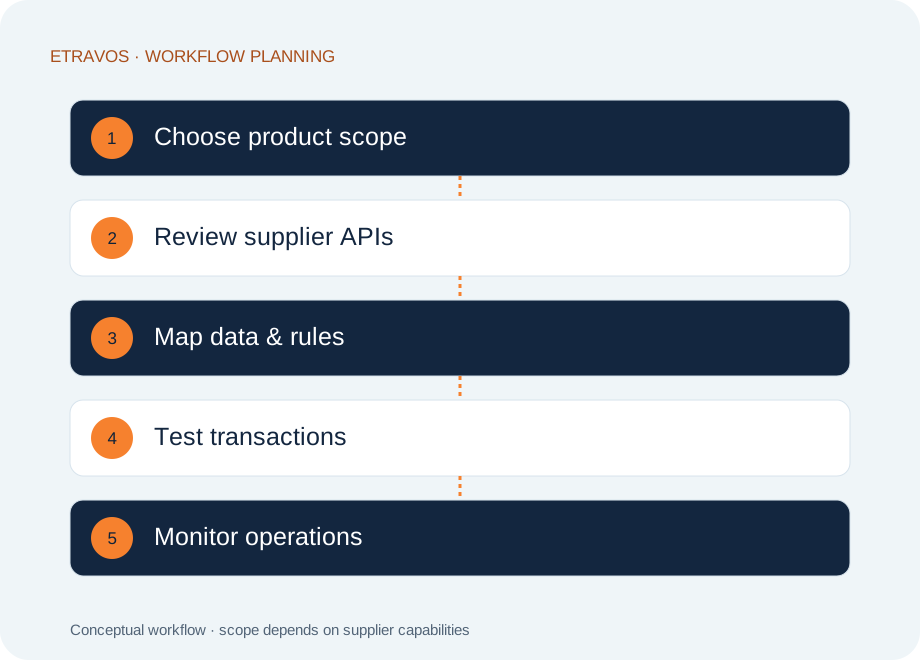
List required operations for each travel product: search, validation, reservation, confirmation, cancellation and status lookup. Mark which are automated, assisted or unavailable. This avoids discovering a servicing gap only after the storefront is complete.
Supplier-specific formats and errors should be handled without scattering special cases across customer screens. Keep commercial rules and presentation separate where practical so a provider change does not force a complete interface rebuild.
Set timeout, retry and reconciliation rules per operation. Search requests and booking requests have different consequences. An error response should produce a useful visitor message and enough operational context for support without disclosing sensitive credentials.
Bring your supplier setup and customer journey. Define the next step with eTravos.
Keep keys server-side, restrict access to customer data and define what is recorded in logs. Confirm image and content rights. Include the retention and deletion requirements of your business in the implementation brief.
Supplier inventory alone does not provide your payment, accounting or agent settlement model. Map identifiers across systems and define reconciliation outputs before launch. Review how cancellation charges and refunds flow through those records.
Start with the supplier and channel combination that addresses your immediate business need. Agree sandbox tests, production approvals, monitoring and support ownership. eTravos can review the proposed architecture and identify what must be confirmed with each supplier.
Compatibility depends on documentation, access permissions, available operations and commercial terms. A technical review is needed before committing to a connection.
Supplier documentation, target channels, products, payment setup, transaction requirements and existing software are the key inputs.
Provide the supplier agreement, technical documentation, sandbox access and the required booking and servicing scope. Confirm credentials and production approval requirements directly with the provider.
No. Available functions depend on the provider, contract and implementation scope. A feature matrix should show what is supported, what needs a manual process and what is planned for a later phase.
Review successful transactions and exception scenarios: timeouts, price changes, duplicate requests, unknown status and cancellation. Agree monitoring, support ownership and reconciliation before enabling production traffic.

Tell us about your business model, suppliers and current software. We will discuss the relevant workflows and confirm the project scope before proposing delivery or commercial terms.
Talk to eTravos →Explore practical guidance on platforms, integrations and booking operations.
Practical insight for travel businesses building connected digital booking and distribution experiences.
Read article →Practical insight for travel businesses building connected digital booking and distribution experiences.
Read article →